One variable often overlooked that causes fluctuation in Month over Month analysis in Web Analytics data (and I suppose other sets of data) is days in the month. February is a prime example where you go from 31 days in January to only 28 in February (except leap years) resulting in an apparent 9.7% loss in traffic.
Below is a chart of assuming steady traffic, meaning the exact same amount of traffic every day for the entire year. See how wildly it swings purely due to the number of days in the month? This is important to keep in mind if you are using M/M analytics.
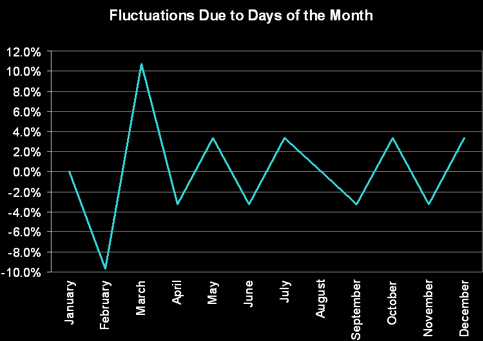
Use the below numbers as a reference to better understand the month-by-month day count analytics bias to help you better explain your monthly reports:
- January: 0.00%
- February: 9.68% loss (6.45% loss during leap year)
- March: 10.71% gain (6.90% gain during leap year)
- April: 3.23% loss
- May: 3.33% gain
- June: 3.23% loss
- July: 3.33% gain
- August: 0.00%
- September: 3.23% loss
- October: 3.33% gain
- November: 3.23% loss
- December: 3.33% gain
One other variable that may be overlooked is the line-up of days in the month. For some this may be the number of weekends in the month, for others it may be the number of Mondays.


March 3rd, 2009 at 5:25 am
Another flavor on this subject: if you’r analyzing a pure B2B site that typicall only has significant activity on business days, then weekends and holidays are trivial — you can see monthly swings from 23 – 19 — a better metric on such sites is average [whatever] per business day when comparing months
March 3rd, 2009 at 10:14 am
Hi, quite interesting post. But it is not quite logic your graphic because when you comparing the %, the same basis should be used. Thus for this reason, the fluctuation is overlooked.
March 4th, 2009 at 1:20 pm
Instead of comparing current month to prior month, do a year over year type analysis where, for example, you compare results from Feb 2009 to Feb 2008. This approach can be applied to any time period (week, month, quarter). If you want to discern a trend in the current year, I suggest looking at a moving average (10 weeks, 3 months, etc.).
March 7th, 2009 at 6:33 pm
I think even not being quite logic, is still very interesting. Thanks for sharing this info. I will like to confirm that my web analytics correlates to what you are saying.
March 11th, 2009 at 8:27 pm
Hey Dustin! It was cool seeing you at SearchFest this year!
July 10th, 2009 at 8:39 am
That is an excellent point, Dustin. I often thought that things “might be off” when doing monthly comparisons, but honestly… not be enough for it to be relevant to the sites whose metrics I track. But your per-month percentage adjustments will be useful to normalize, say, a February compared to a January. But Win’s comment above is important… an extra weekend day for some sites can throw off direct comparisons.
July 10th, 2009 at 5:50 pm
It’s different for everyone, but an extra week day or weekend day could make a difference. It would be nice to have a handy guide for that as well (an endeavor I’ll probably save myself from).
March 24th, 2011 at 8:44 am
[...] Another seasonality-related post: Days in the Month Bias for Analytics [...]